


A Strong Foundation in a Changing Landscape
For decades, telecom operators have built one of the most powerful infrastructures in the global economy. Connectivity has enabled billions of people to communicate, businesses to scale, and entire digital ecosystems to emerge.
Today, this foundation is stronger than ever.
Mobile connectivity reaches 5.83 billion users globally, representing roughly 70.4% of the world’s population (Data Reportal), while digital services continue to expand rapidly. The subscription economy alone is expected to approach $1 trillion by 2028 (Juniper Research).
At the same time, the way value is created within the ecosystem is evolving.
According to PwC’s Global Telecom Outlook 2025–2029, global telecom service revenue is expected to grow from US$1.15 trillion in 2024 to approximately US$1.32 trillion in 2029, representing a CAGR of about 2.8%. At the same time, telecom data consumption continues to increase rapidly, while mobile ARPU is expected to decline slightly from US$6.32 in 2024 to US$6.20 in 2029, illustrating the widening gap between traffic growth and monetization. This reflects a broader shift: growth is no longer driven only by access, but also by how services are used and monetized.
The next layer of telco growth is taking shape not in replacing connectivity, but in transforming it into a stronger engine for digital service adoption, payment, and recurring revenue.
Extending the Role of Telcos
In this context, telecom operators are naturally extending their role within the digital ecosystem.
This evolution is not about moving away from connectivity. It is about building on top of it, and leveraging it as a foundation to create new sources of value.
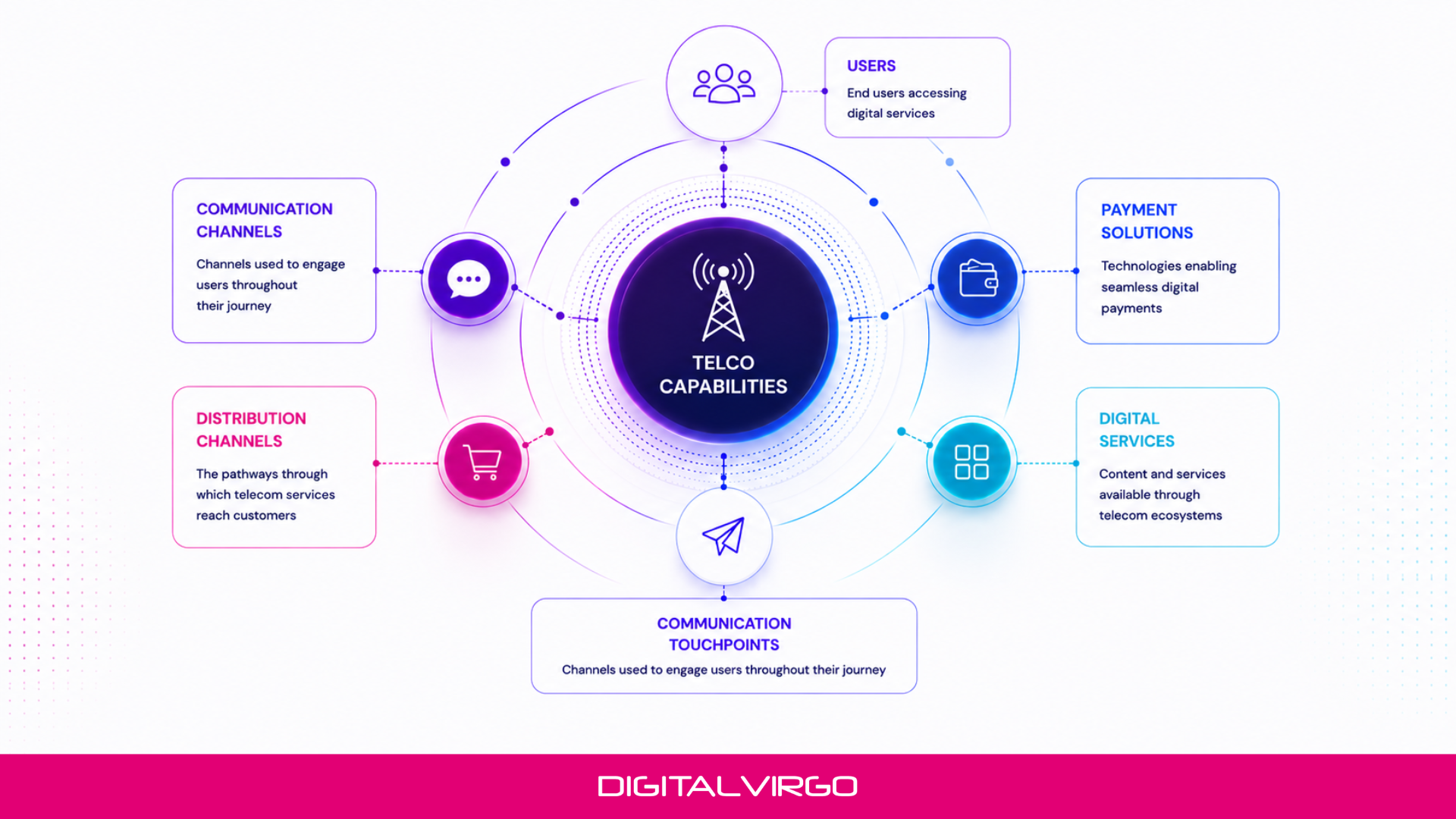
Across markets, this shift is already taking shape. Telecom operators are progressively expanding their scope by distributing a growing range of digital services, enabling seamless and accessible payment solutions, and strengthening direct, ongoing relationships with their users.
What makes this evolution particularly relevant is the position telcos already hold.
With large-scale user bases and integrated billing systems, they operate at a unique intersection within the ecosystem. They connect access to services, user identity, and payment capabilities within a single environment.
This combination creates a powerful framework, one that allows telecom operators not only to enable connectivity, but also to facilitate how users discover, access, and engage with digital services.
This is precisely the space where Digital Virgo operates: at the intersection of telecom infrastructure, digital services, payment technologies, and user engagement. By connecting these capabilities, the Group helps telecom operators transform existing assets into measurable digital revenue opportunities.
Where New Value Is Emerging
The next phase of growth lies in how telecom operators leverage their existing assets. Three areas stand out.
Payments Expanding Access
Payments are a natural extension of connectivity because they build on the relationship telecom operators already have with their users.
Every mobile subscription is not only a connection to a network. It is also a billing and financial interaction point.
Users already rely on their operator to manage their subscription, charge them regularly, and provide a simple and trusted payment experience. Extending this relationship to digital services is therefore a logical next step. Telecom operators can leverage this existing infrastructure to enable transactions directly through the mobile account, without requiring additional tools or complex onboarding processes.
Digital Virgo has observed this evolution across multiple regions, helping operators and digital merchants deploy payment experiences adapted to local markets, user habits, and regulatory environments.
Two payment models illustrate this evolution particularly well.
Direct Carrier Billing (DCB) allows users to pay for digital services through their mobile phone bill. It is especially effective for frictionless, low-value and high-frequency transactions. It represents:
- Global value of DCB transactions will rise from $51 billion in 2026 to more than $87 billion in 2030 (Juniper Research)
- Access to over 1.3 billion unbanked users (World Bank)
Alongside DCB, Mobile Money has become a key pillar of digital payments in many markets. Services such as M-PESA, MTN MoMo, Orange Money or Airtel Money enable users to store money, transfer funds, and pay for goods and services.
In several regions, these services have reached massive adoption. For example, M-PESA counts 40 million active users in Kenya (Safaricom).
While DCB simplifies payments for digital services, Mobile Money enables a broader range of financial transactions, including higher-value payments.
Together, these solutions reflect how telecom operators extend their role beyond connectivity.
In many markets, mobile connectivity is the primary, and sometimes the only, entry point to the digital economy. By embedding payment into this ecosystem, telcos remove one of the biggest barriers to adoption.
Payments therefore do more than facilitate transactions. They expand access, support financial inclusion, and enable entirely new user segments to participate in digital services.
Payment is not only a transaction layer. It is a strategic enabler of access, conversion, and monetization, especially when integrated with the right distribution channels and adapted to local market realities.
Distribution Becoming Strategic
Distribution has always been part of the telecom operators’ role. But in today’s digital environment, its importance is evolving.
As the number of digital services continues to grow, the challenge is no longer only to make services available. It is to make them visible, accessible at the right moment, and easy to activate.
Telecom operators have a strong advantage in this area. They connect services to users through integrated touchpoints such as messaging channels (SMS and RCS), operator portals and marketplaces, and bundled offers embedded into connectivity plans.
Across more than 60 markets, Digital Virgo works alongside telecom operators and digital service providers to structure distribution strategies that combine reach, timing, user experience, and performance. This operational expertise helps transform service availability into real user activation.
What makes these channels particularly powerful is their proximity to the user. Unlike traditional digital distribution, which often relies on external platforms, telecom operators engage users directly within their own ecosystem.
This proximity transforms the role of distribution.
It is no longer only about providing access to services. It becomes a key lever to drive discovery, trigger activation, and sustain engagement over time.
In a highly competitive digital landscape, where users are constantly exposed to multiple offers, visibility and timing are critical.
Being able to surface the right service, at the right moment, through the right channel directly impacts conversion and usage.
Distribution, in this context, becomes a strategic capability, one that directly contributes to how value is created and captured.

Engagement as a Growth Lever
Telecom operators are in a unique position when it comes to user relationships. Unlike most digital players, they interact with users on a continuous basis, not just at acquisition, but throughout the entire lifecycle.
Every message sent, every billing interaction, and every service accessed contributes to an ongoing relationship. This creates a strong foundation to engage users regularly, understand usage patterns over time, and build long-term interaction rather than one-off transactions.
In a digital environment where attention is increasingly fragmented, this continuity is a major advantage. It allows telecom operators not only to reach users, but to remain present in their daily interactions. This changes the nature of value creation.
The focus is gradually shifting from access to usage. What matters is no longer only how users access services, but how often they return, how they interact, and how engaged they remain over time.
By activating users through relevant content, personalized interactions, and recurring touchpoints, telecom operators can increase usage, improve retention, and strengthen the overall value of their ecosystem.
As digital ecosystems mature, sustainable monetization increasingly depends not only on acquiring users, but also on maintaining engagement over time through relevant services and optimized user journeys.
Engagement, in this context, is not just a product feature. It is a driver of long-term performance.

Unlocking the Next Layer of Growth
What emerges from these dynamics is a clear evolution. Connectivity remains the foundation, but value is increasingly created in how this connectivity is activated, extended, and experienced.
Payments expand access.
Distribution drives visibility and activation.
Engagement sustains usage over time.
Together, they form a new layer of value creation, one that builds directly on the core strengths of telecom operators. This shift does not replace the traditional model.
It extends it. It moves telecom operators from enabling access to enabling usage, interaction, and monetization.
However, unlocking this potential requires more than isolated initiatives. It requires the ability to connect payment capabilities with distribution channels, align user experience across touchpoints, and continuously adapt services to market dynamics.
This is where the role of a partner becomes critical. An effective partner is not only a technology provider. It brings a deep understanding of telecom ecosystems, connects operators with a wide range of digital service industries, and enables the design and deployment of scalable, localized monetization strategies.
Operating at the intersection of telecom infrastructure, digital services, payment technologies, and user engagement, Digital Virgo helps telecom operators transform existing assets into scalable and measurable revenue opportunities across more than 60 markets worldwide.
The opportunity is clear: unlock the full potential of connectivity by building the right services, with the right partners, on top of it.


