


The Rise of Aggregation
The digital economy has never offered so many possibilities.
Streaming platforms, gaming subscriptions, financial services, mobility apps, education platforms, cloud storage, AI assistants… Users now navigate an ecosystem of hundreds of digital services every day.
This growth is taking place in an increasingly mobile-first environment. According to GSMA Intelligence, the mobile industry supports 8.8 billion wireless connections, including 5.8 billion unique subscribers, around 70% of the global population.[1]
DataReportal also highlights the central role of mobile in digital usage: 96.2% of internet users use a mobile phone to go online at least some of the time, while mobile phones account for 51.6% of global web traffic.[2]
But more choice does not always create a better experience.
Each new service often comes with another application to install, another account to create, another payment method to manage and another subscription to remember. What was designed to simplify everyday life has gradually become increasingly fragmented.
Users are asking for easier ways to access the services they already value. This is where aggregation comes into play.
Rather than multiplying destinations, aggregation brings services together into a single, coherent environment, reducing friction while creating a simpler and more intuitive customer experience.
For telecom operators, this evolution represents far more than a user experience improvement. It opens the door to a new role within the digital ecosystem: helping users discover, activate, pay for and engage with digital services through trusted, operator-led environments.
It also creates a clear need for execution partners able to connect the different layers of this ecosystem: services, technology, payments, distribution, marketing and monetization.
Digital Virgo Insight
Aggregation is not only a platform strategy. It is an execution challenge. Digital Virgo operates at the intersection of telecom infrastructure, digital services, payment technologies and user engagement, helping telecom operators transform existing assets into scalable digital revenue opportunities across more than 60 markets.[11]
Three Models Reshaping Digital Access
Aggregation is taking several forms across the market, but three models are emerging as the dominant gateways to digital services.
Super Apps: Reinventing the Telecom Experience
Originally popularized in Asia by platforms such as WeChat, Grab and Careem, the super app model has demonstrated the power of bringing multiple digital services together within a single application.
The scale of these ecosystems shows why the model has become so influential. Tencent reports that Weixin and WeChat exceeded 1.4 billion monthly active users at the end of Q1 2026. Its ecosystem also integrates Mini Programs, Weixin Pay, Mini Games and other digital services within one mobile environment.[3]
In Southeast Asia, Grab also illustrates the strength of multi-service platforms, reporting that it crossed 50 million monthly transacting users in 2025.[4]
Today, this approach is expanding well beyond Asia. Around the world, telecom operators are adapting the concept to their own markets, building digital ecosystems that reflect local customer expectations, available services and regional payment habits.
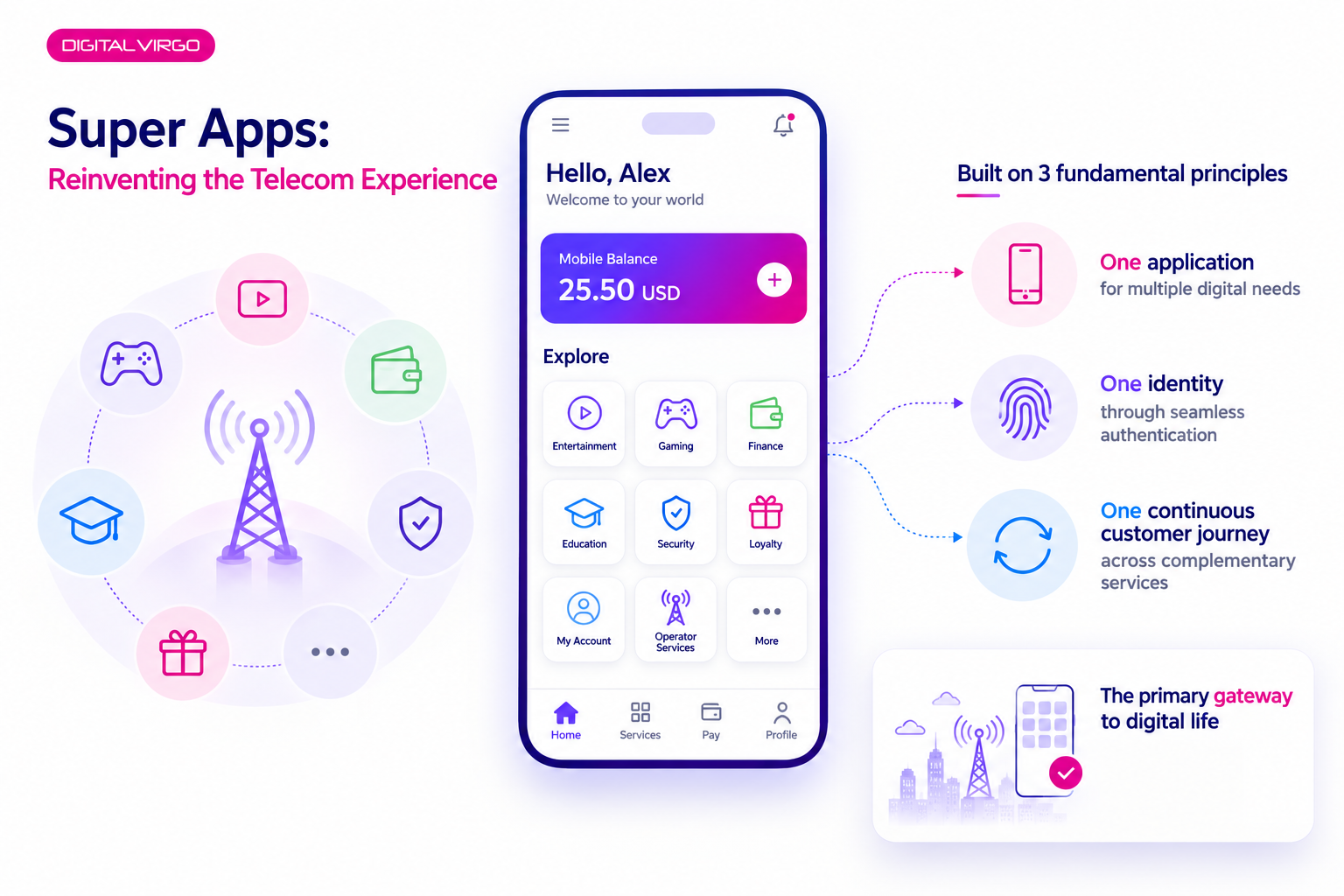
Within a telecom super app, subscribers can seamlessly access a growing range of digital experiences, from entertainment and gaming to financial services, loyalty programs, account management and operator services, all from a single interface.
The model is built around three fundamental principles:
- One application for multiple digital needs.
- One identity through seamless authentication.
- One continuous customer journey across complementary services.
For telecom operators, the objective goes beyond convenience. By bringing digital services together in a single environment, they strengthen customer engagement, increase the visibility of partner services and position themselves at the center of the digital experience.
But building a telecom super app is not only about launching an application. It requires the ability to source relevant services, adapt them locally, integrate trusted payment flows, activate users and keep engagement alive over time.
This is where Digital Virgo brings operational value. In its analysis of African super apps, Digital Virgo highlights the importance of trusted payments, local adaptation, digital marketing, loyalty mechanics and service integration to make these ecosystems work in practice. The article also notes that, after two years of collaboration, the Max it experience operates in nine African countries, integrating ten Digital Virgo local services through web views, mini-apps and native modules.[5]
Rather than directing users toward multiple disconnected applications, telecom super apps become the primary gateway through which customers discover, access and manage their digital lives.
Marketplaces: Organising Digital Discovery
Alongside super apps, digital marketplaces have become one of the most effective ways for telecom operators to organize and distribute digital services.
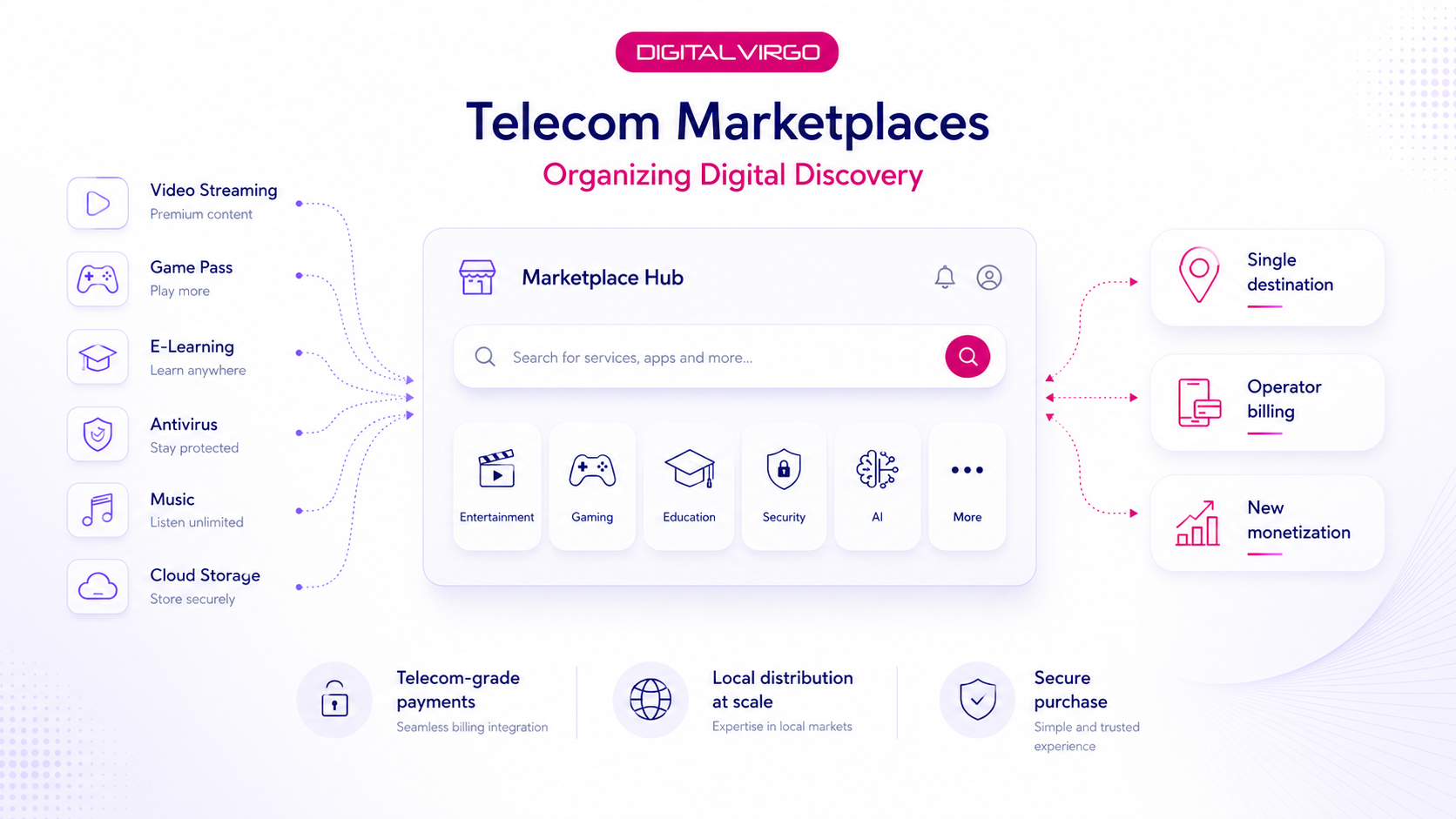
Rather than navigating multiple providers, customers can discover, compare and activate a wide range of services from a single destination designed and operated by or for their telecom provider.
These marketplaces bring together entertainment, gaming, education, security, lifestyle, streaming and AI services within a consistent, easy-to-use environment, making digital discovery simpler while reducing friction throughout the customer journey.
For telecom operators, the benefits go well beyond user experience. A marketplace strengthens customer relationships, creates new monetization opportunities and reinforces the operator’s position as the preferred gateway to digital services.
At Digital Virgo, this model is already part of the Group’s operational expertise. Digital Virgo designs and operates white-label marketplaces and thematic hubs for telecom operators, integrating premium digital services, payment flows, acquisition campaigns, advertising levers and distribution strategies into a single performance-driven environment.
Digital Virgo’s Content & Marketplace offer includes a catalogue of premium apps and services across categories such as music, TV and streaming, VOD, lifestyle, gaming, e-sport, kids, parenting, sport and cooking. The Group also states that it connects operators to 300+ merchants worldwide, with services available in white label, hubs, stores or marketplaces.[6]
This approach is not limited to content aggregation. It also includes payment and monetization. Digital Virgo’s DV PASS platform connects merchants, OTTs and telcos through one single API to enable secure digital transactions worldwide, supporting Direct Carrier Billing, Mobile Money, eWallets and local payment methods.[7]
This payment layer matters because carrier billing remains a significant growth opportunity. Juniper Research estimates total end-user spend via carrier billing at $75.1 billion in 2024, with a forecast of $136.9 billion by 2029.[8]
In many markets, Mobile Money also plays a critical role in making digital services more accessible. GSMA reports that mobile money services processed more than $2 trillion in transactions in 2025, underlining the importance of payment methods adapted to local usage and financial habits.[9]
Much like an app store, telecom marketplaces centralize service discovery, but with the added advantage of telecom-grade payment integration, local distribution expertise and a seamless user journey.
The relevance of this model is also illustrated by Digital Virgo’s MEFFYS26 Award for its Multi-Tenant OTT & Streaming Marketplace, a cloud-based ecosystem designed to help telecom operators launch scalable and monetizable streaming services.[12]
Bundles: Turning Complexity into Value
Bundles represent another powerful form of aggregation.
Instead of managing several independent subscriptions, users access multiple services through a single package, with one payment and one customer relationship.
This significantly reduces subscription fatigue while increasing the perceived value of each offer.
The shift toward bundling is already visible in the streaming economy. Deloitte expects aggregation to play a growing role in the video industry and notes that, in the UK, 43% of SVOD subscribers surveyed had purchased at least one service via another party, such as a pay TV provider, telco or tech platform, as of September 2024. Deloitte also expects aggregators to offer combinations of single accounts, single bills, optional content channels, centralized marketing and advertising capabilities.[10]
For telecom operators, bundled services create multiple strategic advantages:
- Higher average revenue per user.
- Improved customer retention.
- Stronger service adoption.
- Greater differentiation in competitive markets.
But successful bundling is not simply about grouping services together. It requires the right content portfolio, relevant local partnerships, technical integration, payment orchestration, marketing activation and performance monitoring.
This is where Digital Virgo’s model fits naturally. The Group supports telecom operators by sourcing and integrating premium digital services, enabling operator billing and local payment methods, building white-label environments, supporting acquisition and advertising strategies, and packaging services into offers adapted to each market.
Digital Virgo also describes bundled operations as a way to reinforce engagement and customer experience through partnerships with leading merchants in their content categories. Beyond payment connection, the Group provides customized and turnkey bundles designed to be deployed easily and quickly.[6]
As consumers increasingly seek convenience over abundance, bundled experiences become a natural extension of aggregation.

Why Aggregation Is Winning
The success of aggregation models is not driven by technology alone. It is driven by changing customer expectations. Across markets, users consistently seek three things.
Simplicity
- One application.
- One login.
- One payment.
Every additional step creates friction. Aggregation removes it.
Control
Centralized platforms make subscriptions easier to manage, spending easier to understand and services easier to organize.
Customers regain visibility over increasingly complex digital lives.
Engagement
The easier services become to access, the more frequently they are used.
Reducing friction naturally increases engagement while strengthening customer loyalty.
In a digital economy defined by abundance, simplicity becomes a competitive advantage.
A Strategic Shift for Telecom Operators
For telecom operators, aggregation is far more than a new product strategy. It represents a shift in their position within the digital value chain.
Traditionally, operators have enabled connectivity. Aggregation allows them to go one step further by becoming the gateway through which users discover, activate and manage digital services.
This transition changes the nature of their relationship with customers.
Instead of facilitating access to networks, operators begin facilitating access to the digital economy itself.
That evolution creates new opportunities to strengthen customer relationships, generate additional revenue streams and build long-term ecosystem value.
But this shift requires more than strategic intent. It requires an operational layer capable of connecting services, payments, technology, marketing and local execution. Across more than 60 markets, Digital Virgo works alongside telecom operators and digital service providers to structure distribution strategies that combine reach, timing, user experience and performance.[11]
From Connectivity to Customer Ownership
The real transformation goes beyond technology.
It changes who owns the customer journey.
Rather than simply connecting users to external services, telecom operators can increasingly orchestrate how those services are accessed, consumed and monetized.
Owning the entry point means owning a larger share of the customer experience.
It also creates stronger opportunities around:
- Customer engagement.
- First-party data.
- Personalization.
- Service discovery.
- Monetization.
The distribution layer itself becomes a strategic asset.
For Digital Virgo, this distribution layer is where technology and business execution meet: integrating services, enabling telecom payment, activating users, managing performance and adapting offers to local markets.
Why Telcos Are Uniquely Positioned
Unlike many digital players, telecom operators already possess the essential building blocks required to make aggregation successful.
They benefit from:
- Trusted customer relationships.
- Large existing user bases.
- Integrated billing capabilities.
- Direct communication channels.
- Strong local market presence.
These assets are difficult to replicate.
In emerging markets especially, where operators often play a central role in digital inclusion, aggregation represents a natural extension of their existing position within the ecosystem.
Rather than competing with every digital service, operators can become the platform that brings them together.
The opportunity is particularly strong when operators work with partners able to combine global expertise with local execution. In Southeast Asia, Digital Virgo recently reinforced telecom partnerships across key markets, supporting digital service publishers in deploying, distributing and monetizing services through operator ecosystems adapted to local user habits.[13]
The same logic applies in Africa. Through its partnership with Moov Africa Chad, Digital Virgo launched data bundles coupled with casual gaming and TV services, using carrier billing to make premium entertainment accessible through mobile airtime.[14]
Control the Gateway, Capture the Value
The next competitive battle in the digital economy is no longer about offering the greatest number of services.
It is about becoming the place where users naturally begin their digital journey.
Super apps, marketplaces and bundled experiences are reshaping how services are discovered, distributed and monetized.
For telecom operators, this is an opportunity to evolve from connectivity providers into digital ecosystem orchestrators.
For Digital Virgo, it is also where the Group’s business model creates value: connecting telecom operators, digital service providers, content creators and brands through payment capabilities, content distribution, digital marketing, multi-channel activations and localized monetization strategies.[15]
The question is no longer whether aggregation will define the future of digital services.
It is who will own the gateway – and who will have the right partners to build, operate and monetize it.
Continue the Conversation
Explore more insights from Digital Virgo on how telecom operators can move beyond connectivity and become gateways to digital experiences.
- From Connectivity to Revenue: The Next Step for Telcos in the Digital Economy
- Subscription Overload: When Growth Becomes a Challenge
- Super Apps: Shaping Africa’s Next Digital Chapter
- The State of Direct Carrier Billing in 2026
- Digital Virgo Wins MEFFYS26 Award for Its Multi-Tenant OTT & Streaming Marketplace
Sources
[1] GSMA Intelligence – The Mobile Economy 2026
[2] DataReportal – Digital Around the World / Global Digital Overview
[3] Tencent – Weixin & WeChat official product page
[4] Grab – Fourth Quarter and 2025 Results
[5] Digital Virgo – Super Apps: Shaping Africa’s Next Digital Chapter
[6] Digital Virgo – Content & Marketplace for Telcos
[7] Digital Virgo – DV PASS Carrier Billing & Payments Platform
[8] Juniper Research – Carrier Billing Market Research Report
[9] GSMA – Mobile Money accounted for $2 trillion in transactions in 2025
[10] Deloitte – The shift to streaming bundles
[11] Digital Virgo – From Connectivity to Revenue
[12] Digital Virgo – MEFFYS26 Award for Multi-Tenant OTT & Streaming Marketplace
[13] Digital Virgo – Strengthening Telecom Partnerships Across Asia

