


A Market Still Growing, and Accelerating
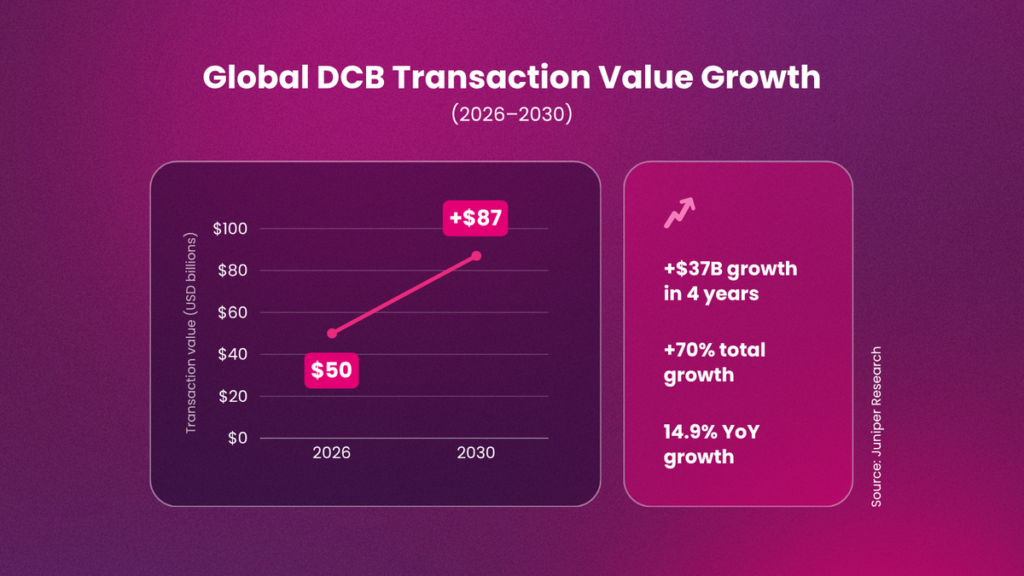
The global Direct Carrier Billing market continues to expand at a steady pace, driven by increasing demand for digital content, subscription models, and mobile-native consumption. According to Juniper Research, the total value of DCB transactions is expected to grow from approximately $50 billion in 2026 to more than $87 billion by 2030, representing an increase of over $37 billion in just four years.
This growth is not incidental. It reflects a structural shift in how users’ access and pay for digital services. Subscription-based economies are booming, with global subscription revenues forecast to reach $1.2 trillion by 2030 (Juniper Research). In parallel, mobile usage continues to dominate digital interactions, making mobile-first payment methods increasingly critical.
DCB sits precisely at the intersection of these trends.
Why DCB Still Outperforms on Conversion
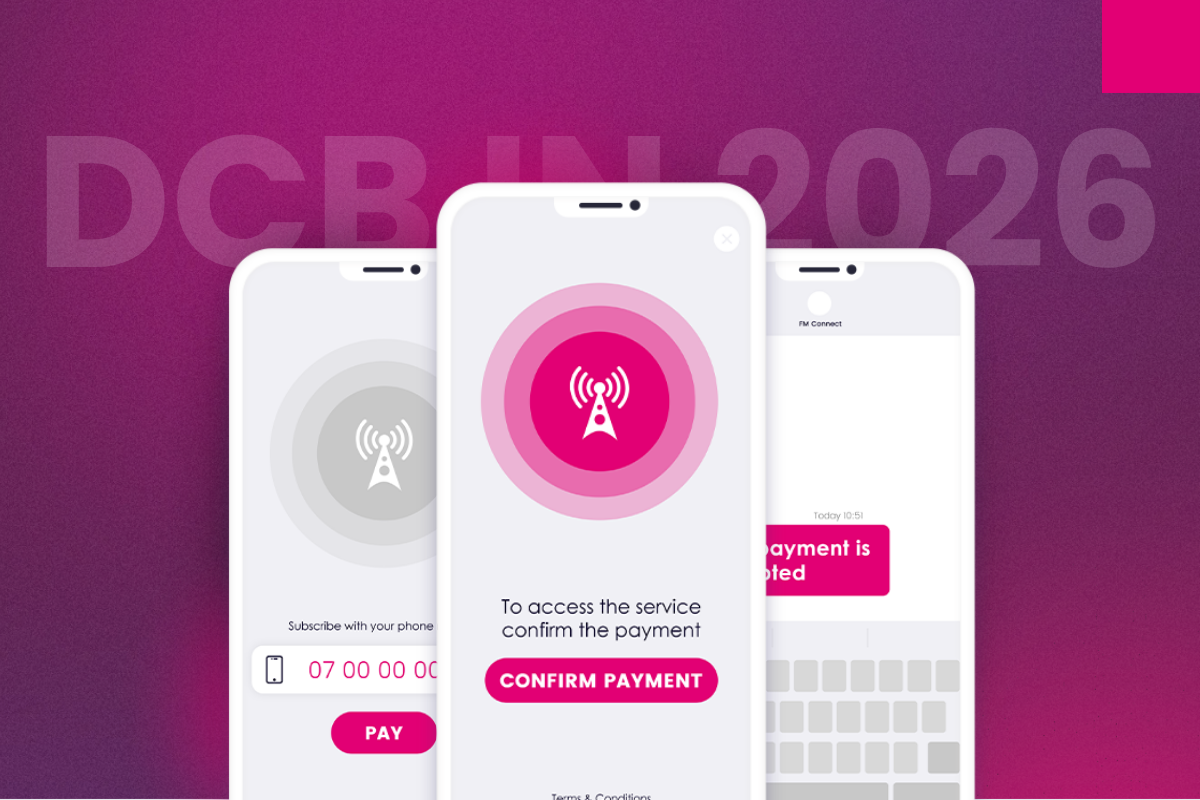
At its core, Direct Carrier Billing is designed to remove friction. By allowing users to charge purchases directly to their mobile phone bill or prepaid balance, it eliminates the need for card entry, account creation, or banking credentials at the point of purchase.
This simplicity has a direct and measurable impact on conversion rates.
In digital environments where every additional step reduces the likelihood of completion, DCB offers a streamlined experience that aligns perfectly with impulse-driven consumption. This is particularly relevant for:
- Subscription sign-ups
- In-app purchases and microtransactions
- Digital content access such as video, music, and gaming
Juniper Research’s latest report on the topic highlights that DCB’s frictionless nature not only increases initial conversion but also compounds value over time in subscription models, where improved onboarding translates into longer customer lifetime value.
From a behavioural perspective, the ability to defer payment to the monthly bill or deduct from prepaid credit creates a psychological distance from spending, further encouraging frequent, low-value transactions. This makes DCB especially effective in high-frequency purchase environments such as mobile gaming and digital content ecosystems.
Expanding Reach: Financial Inclusion and Global Penetration
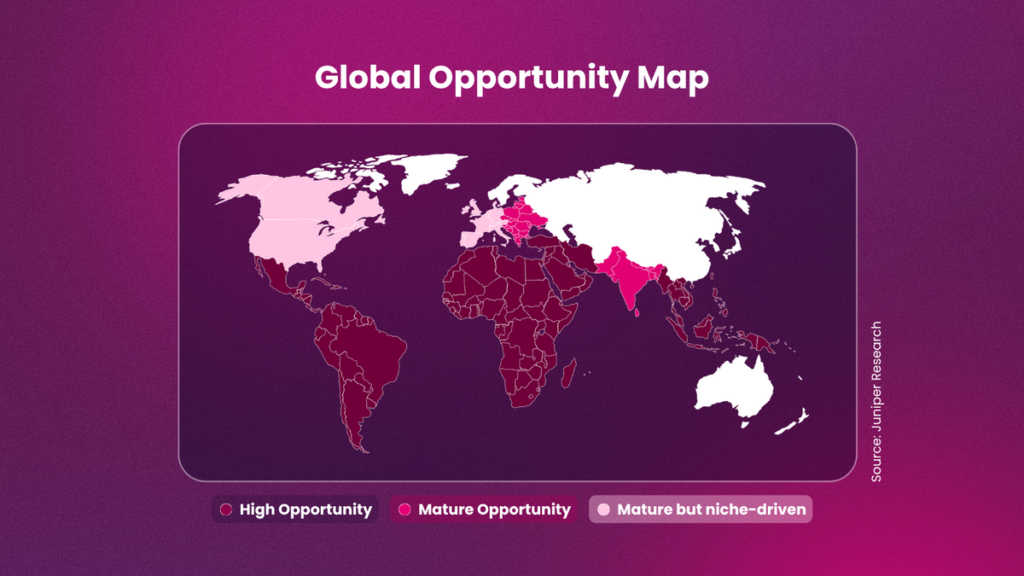
One of the defining strengths of DCB in 2026 remains its accessibility. Unlike traditional payment methods, it does not require a bank account or credit card, making it a critical enabler of digital commerce in regions with low banking penetration.
In many emerging markets across Africa, Latin America, Southeast Asia, and parts of the Middle East, mobile penetration far exceeds access to financial services. In these regions, DCB is not simply an alternative payment method, it is often the primary gateway to digital services.
This accessibility allows telecom operators to play a central role in financial inclusion while enabling merchants to reach previously untapped user segments. For global digital players, integrating DCB is often the fastest way to scale in mobile-first economies.
At the same time, DCB continues to perform strongly in more mature markets, particularly in specific use cases where convenience and speed are critical. This dual relevance across both emerging and developed economies reinforces its global importance.
Key Growth Verticals in 2026
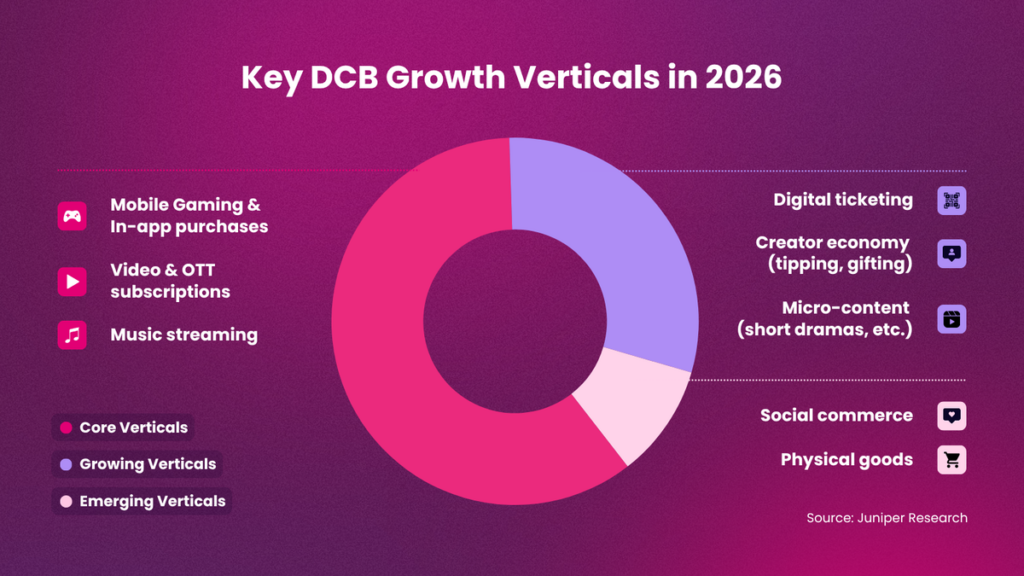
The evolution of Direct Carrier Billing is closely tied to the expansion of digital ecosystems. While traditional verticals remain strong, new opportunities are emerging rapidly.
Digital entertainment continues to lead. Video streaming, music platforms, and mobile gaming remain the backbone of DCB usage, supported by subscription and microtransaction models that align naturally with carrier billing.
Beyond these established segments, new growth areas are gaining traction.
The creator economy is becoming a significant driver, with tipping, digital gifting, and fan monetization relying heavily on frictionless, spontaneous payments. Social media platforms and short-form content ecosystems are increasingly integrating monetization features that benefit directly from DCB’s simplicity.
Digital ticketing is another promising vertical. As more services move online, from public transport to live events, DCB offers a convenient solution for smaller, frequent transactions. This segment is gaining momentum, particularly for low-value purchases where speed and ease of use are essential.
Looking ahead, the expansion into physical goods and social commerce presents additional opportunities, although this will require more flexible pricing models and regulatory adaptation.
Addressing Challenges: Trust, Standardization, and Economics
Despite its strengths, DCB faces several challenges that must be addressed to sustain its growth.
Trust remains a key factor. In some markets, past issues related to subscription practices have impacted user confidence. Rebuilding trust requires strong regulatory frameworks, transparent user journeys, and robust customer care mechanisms.
Fragmentation is another challenge. Differences in integration models, user flows, and technical standards across operators can create complexity for merchants operating at scale. Initiatives such as GSMA Open Gateway and standardized network APIs are expected to play a crucial role in addressing this issue by simplifying integration and accelerating deployment across markets.
From a commercial perspective, transaction fees have historically limited adoption in certain verticals, particularly for physical goods. As the ecosystem evolves, more flexible and volume-driven pricing models will be essential to unlock new use cases.
Finally, fraud prevention is central to the sustainability of the ecosystem. Advanced anti-fraud systems, real-time monitoring, and the use of network-based APIs such as number verification are becoming critical components of modern DCB infrastructures.
The Role of Technology in the Next Phase of Direct Carrier Billing
The next phase of Direct Carrier Billing will be defined by technology standardization, API-driven ecosystems, and enhanced user experiences.
The emergence of network APIs through initiatives like Open Gateway is transforming DCB into a more scalable and developer-friendly solution. By enabling consistent integration across operators, these APIs reduce complexity and accelerate time-to-market for merchants.
At the same time, conversational commerce is opening new frontiers. Rich Communication Services (RCS) allows payments to be embedded directly within messaging environments, creating a seamless journey from interaction to transaction. In this context, DCB becomes a natural payment layer within native mobile experiences.
These innovations are not only improving conversion rates but also expanding the range of use cases where DCB can be applied.
Digital Virgo’s Perspective: Building a Scalable and Secure Ecosystem
As the DCB ecosystem evolves, the ability to combine connectivity, monetization, and performance optimization becomes a key differentiator.
Digital Virgo’s approach reflects this shift. Through its DV PASS platform, the company provides a unified, secure, and scalable infrastructure for managing carrier billing flows across multiple markets. By offering a single API entry point, advanced fraud prevention, real-time analytics, and lifecycle management tools, DV PASS simplifies integration while enhancing performance and control.
Beyond technology, Digital Virgo emphasizes a holistic model that integrates payment capabilities with user acquisition, data analysis, and local market expertise. This end-to-end approach enables both telecom operators and merchants to maximize conversion rates while ensuring compliance and long-term sustainability.
With a presence in over 60 countries and strong local expertise, Digital Virgo is positioned to support the global expansion of DCB while adapting to the specific requirements of each market.
A Payment Method Built for the Mobile Economy
In 2026, Direct Carrier Billing is no longer just a complementary payment option. It is a strategic enabler of digital commerce, particularly in mobile-first environments.
Its ability to combine accessibility, simplicity, and performance makes it uniquely suited to the evolving needs of both consumers and businesses. As digital ecosystems continue to expand, and as new monetization models emerge, DCB is set to play an even greater role in shaping the future of payments.
For telecom operators, it represents a powerful opportunity to diversify revenue streams and strengthen their position in the value chain. For merchants, it offers a proven way to increase conversion, reach new audiences, and unlock global growth. Direct Carrier Billing’s strength in 2026 lies in its ability to adapt. By combining frictionless user experiences with technological innovation and global reach, it continues to prove that in the world of digital payments, simplicity remains one of the most powerful drivers of performance.